Metric Units Are Quietly Costing You American Viewers
The script is good. The voice is clean. The footage cost real money. And American viewers still leave in the first thirty seconds, without ever being able to tell you why.
One of the quietest reasons is something most creators never think of as content at all: the units. Say that a house is a hundred and twenty square metres, or that the day hit thirty-five degrees, and an American viewer has no picture. Not a wrong picture — no picture. Big or small? Hot or mild? For half a second they are doing arithmetic instead of watching, and underneath the arithmetic sits a thought that costs you far more than the pause: this was not made for me.
Why a unit decides how close the video feels
Making videos for an audience in another country is not a translation job. Correct grammar gets you to the starting line. What you are actually trying to do is write like somebody inside that audience — and units are one of the few places where an outsider gives themselves away in a single word.
Viewers do not analyse this. They feel it. Something is slightly off, slightly imported, and in a feed where the decision to stay is made in a few seconds, slightly off is enough.
Americans think in feet, pounds and Fahrenheit
Most of the world runs on metric. The United States mostly does not. Height comes in feet and inches, weight in pounds, temperature in Fahrenheit, distance in miles, fuel and drinks in gallons and ounces. Metric shows up in science, medicine and running, and almost nowhere else in daily speech.
So when you say a man is one point eight metres tall, an American viewer has to convert. When you say five foot eleven, they see him. Neither system is more correct. One of them is the language their head already runs in, and good writing never makes the audience translate while they watch.
Converting is not the same as localising
Here is the mistake people make immediately after learning the first lesson: they run every number through a converter and record the result.
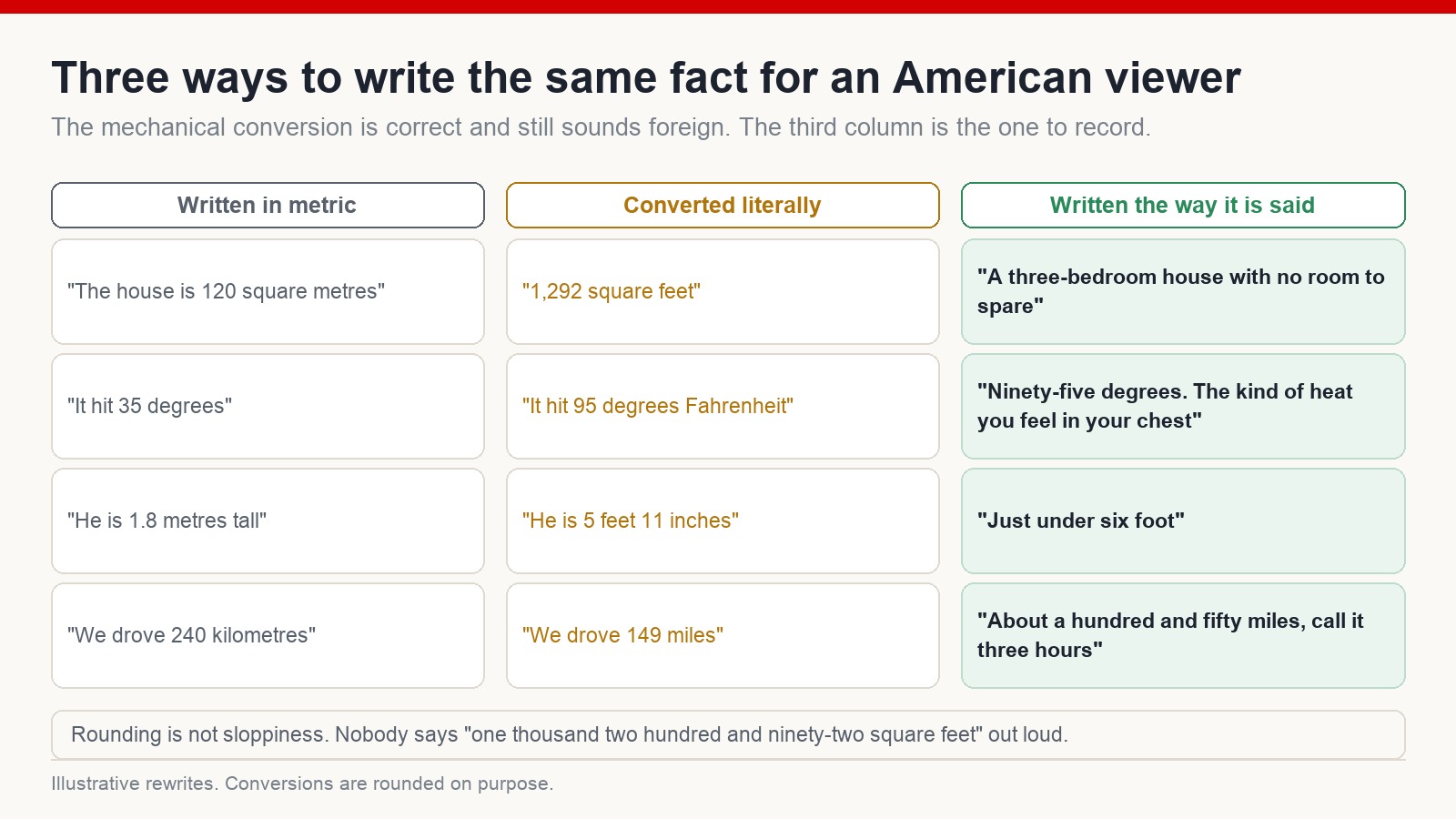
A hundred and twenty square metres becomes one thousand two hundred and ninety-two square feet. Technically right. Nobody says that. Human speech rounds, and it usually prefers a picture to a figure: a three-bedroom house with no room to spare. Two hundred and forty kilometres becomes a hundred and forty-nine miles, which no person has ever said out loud — about a hundred and fifty miles, call it three hours is what they would say.
Rounding is not sloppiness. In spoken narration, an unrounded number signals that the sentence came out of a spreadsheet rather than a mouth.
Sometimes the number should go entirely
Ask what the figure is doing. If it carries the meaning — a record, a measurement the story turns on — convert it and round it. If the precision was never the point, replace it with the experience. Thirty-five degrees means nothing to an American. Ninety-five degrees means something. The kind of heat you feel in your chest means it to everybody.
And if you cannot source the number, cut it. An impressive figure nobody can verify costs more trust than it buys, and a viewer who catches one wrong number listens to the rest of the video differently.
The small stuff compounds into a judgement
A single odd unit does not make anyone close the tab. What it does is contribute to a quiet verdict: this channel is not really from here. Maybe it is machine-translated. Maybe it is recycled from somewhere else. Once that suspicion exists, everything afterwards is heard with a little scepticism, and scepticism shows up in watch time long before it shows up in the comments.
Trust on a video is built from dozens of details that all agree with each other. It also erodes from the few that do not.
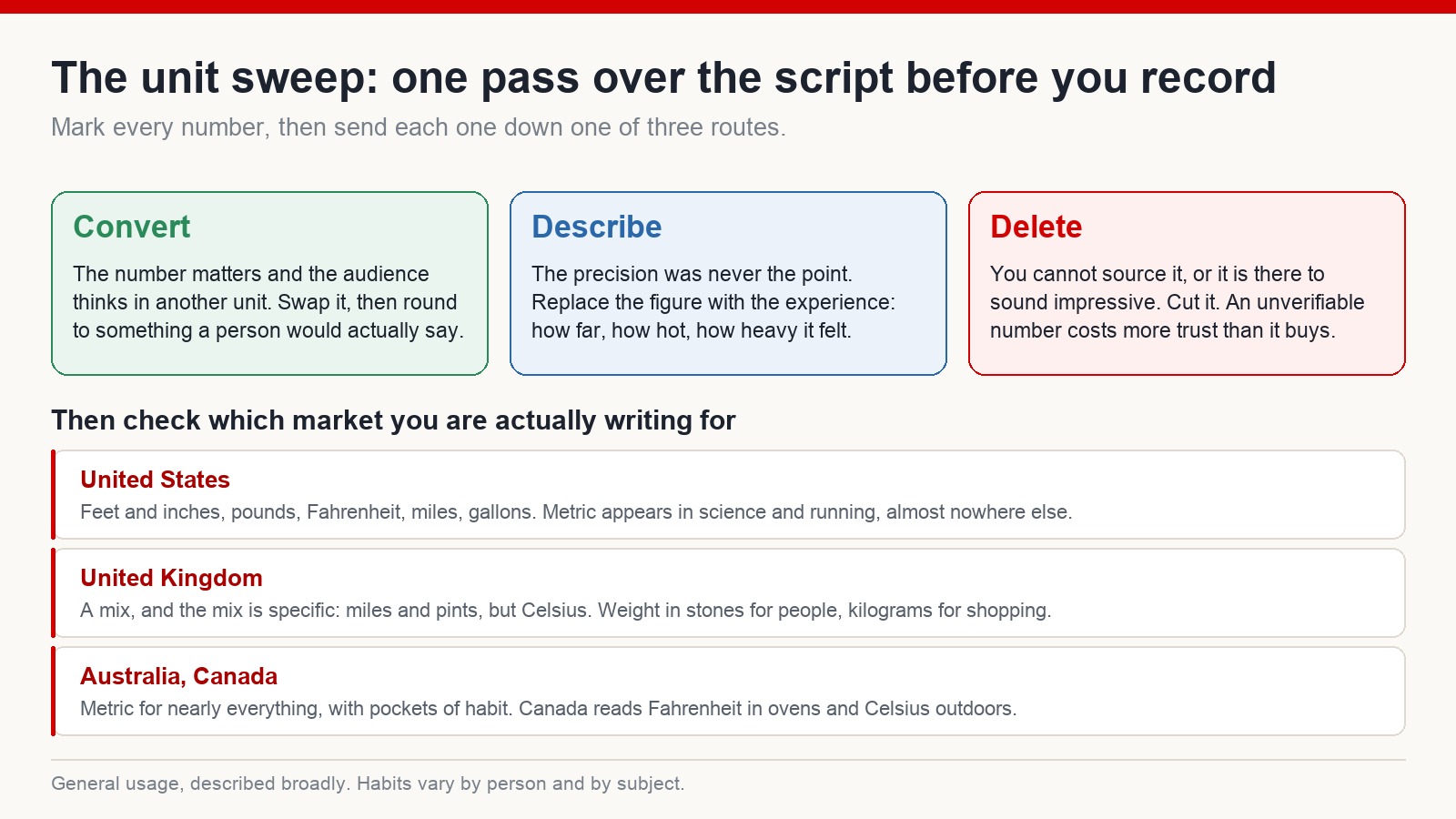
The unit sweep: five minutes before you record
Add one small step to the routine. When the script is finished and before you sit down to record, read it once looking only for numbers. Mark every unit. For each one, choose a route: convert and round, replace with a description, or delete.
It takes about five minutes on a normal script. After a handful of videos it stops being a step at all, because you start writing in the audience’s units from the first draft.
Check which audience you actually have
“English-speaking” is not one measurement culture, and this is where a lot of scripts get it half right.
The United States is imperial almost everywhere in daily life. The United Kingdom is a specific mix: miles and pints, but temperature in Celsius; body weight in stones, shopping in kilograms. Australia is metric in nearly everything. Canada is officially metric with pockets of habit — a recipe in Fahrenheit, the weather in Celsius.
So the question is not “should I use imperial”, it is “who is watching”. Open the analytics, look at where the audience actually sits, and write for the largest group rather than for a generic idea of the West. If the audience is genuinely split, pick the primary market and stay consistent; switching systems inside one video is worse than choosing the less common one.
Beyond units, the same reflex applies
Units are the easiest thing to catch, which is why they are worth fixing first. But the habit underneath them is the valuable part: write with the audience’s frame of reference, not your own. That same reflex will later catch a currency they have to look up, a date written the way nobody there writes dates, a school system or a holiday used as though everyone shares it, and an idiom that translates into grammatical nonsense.
None of these details is individually large. Together they are the difference between a channel that reads as imported and one that reads as local. Viewers rarely say “this feels foreign”. They just leave, and you see it as a curve that drops early for reasons the analytics will never explain.
Frequently asked questions
Should I use imperial units for all English-language videos?
No. Use whatever the largest part of your audience thinks in. That is imperial for a mostly American audience, a mix for the UK, and metric for Australia. Check the analytics rather than guessing.
Can I give both units, like “35C (95F)”?
It reads fine on screen and badly in narration. In text, dual units are helpful. Spoken aloud, they interrupt the sentence — pick one for the voiceover and put the other on screen if you need it.
What if the exact number matters?
Then convert it properly and say it in a natural form. Precision and natural speech are not in conflict; the problem is only the unrounded conversion of a figure that was approximate to begin with.
Does any of this really change retention?
No single unit does, and anyone promising you a number is guessing. The reasonable claim is smaller: every detail that makes an audience feel the video was written for them removes one small reason to leave.
If you want the full process for building a faceless channel aimed at English-speaking audiences, that is what I teach at mmoyoutube.com.